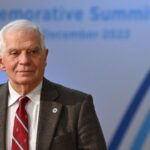
Imperial perception of the world and its place in it is one of the key features of Russia’s political outlook, but for almost 30 years its position has been passive. After transitioning to an active phase, most Europeans believe that Kremlin’s appetites stop at certain borders of Ukrainian regions, not realizing that Ukraine itself does not satisfy the empire’s needs as planned by the Kremlin. Is it worth for the people of European countries to remain in this illusion? This was the topic discussed by Josep Borrell, the High Representative of the EU, during his speech at Oxford.
So it’s calmer
Of course, considering that Russia does not plan to intervene in Europe if given Ukraine is a very advantageous point of view, especially for politicians who do not plan for a long-term career. Otherwise, they would have to implement a series of unpopular decisions that would worsen the economy, reduce social protection for people, and so on, ultimately alienating the electorate. However, in the long term, such a policy would save the states from destruction or complete transformation according to Russia’s vision and, in general, help save a large number of lives. So the question is existential and complex: whether to fight for the good in the future, losing political points now, or to pursue a brilliant political career.
Not as scary for some
And if the answer to this question is obvious for a number of countries directly under threat, it is also important not to forget about the third countries in this game, where there may be no hostilities at best, and they will not be subjugated by Russia directly. For them, there is an option to somehow survive the European catastrophe, adapt a little, maybe cooperate in some way with the aggressive and powerful opponent to avoid major losses, without which – importantly – the state will not be exposed to great risks. Currently, a lot depends on such countries.
Is Ukraine worth such losses
Borrell clearly explained that in Putin’s plans, Ukraine is just an intermediate option. It’s hard to disagree with this when analyzing the situation. Why suffer such losses, undermine the Russian economy, practically destroy all the achievements of the last decades just for the annexation of territories of a few Ukrainian regions? Even the Russians themselves no longer believe in fairy tales about “saving Russian speakers.” Obviously, the goal is more global and aimed at the future.
Borrell himself explains that Putin’s success in Ukraine will lead to the formation of a puppet government in Kyiv (exactly the same scheme as in Belarus). After that, Russia will control 44% of the global grain market while being on the borders of Europe. The strength of this position is hard to imagine for the average European. But Borrell urges everyone to realize all the real risks and perspectives.
Time to Admit Defeat
It’s time to admit that Europe has seriously miscalculated: while it was trying to create a comfortable environment with friends, it found itself squeezed between the Sahel countries (Senegal, Mauritania, Mali, Burkina Faso, Niger, Nigeria, Chad, Sudan, and Eritrea) and the Middle East, from the Caucasus to the war in Ukraine. The international system that ensured peace after the end of the “Cold War” is now completely destroyed. Additionally, America lost its hegemonic status as a base of stability in the world order. Thus, there is a very serious threat, and the sooner Europe realizes it, the more chances there are to avoid devastating consequences.
According to Borrell, the majority of politicians in the European Council acknowledge this. Understanding came slowly and difficultly, starting from 2008 after Georgia, then in 2014 with the situation in Crimea. Europeans then ignored Putin’s evolution, who moved from dreams of former greatness and the restoration of the empire to a real plan.
In 2008, this plan was very simple to stop, but now the moment has been lost. It’s especially regrettable that Putin himself revealed his plans during the 2007 Munich conference, but his words were ignored. No one wanted to hear, analyze, and believe in what was approaching. And it’s not just negligence: this is the main function not only of individual politicians, but also of various well-known international organizations.
A Model That Doesn’t Work
For a long time, Europe developed and implemented a model in which cooperation and mutual economic dependence were seen as a guarantee of peace. This scheme did work for 70 years, and Europeans hoped that Russia and China would gradually join it. But these hopes were mistaken; on the contrary, Russian authoritarianism made Europe a hostage to fossil fuels, and this dependence turned into a weapon.
As current events show, more and more European leaders are going through a difficult process of facing reality. A clear example is French President Macron, who recently urged against “humiliating Russia.” Now Macron speaks openly about the global consequences of Russia’s victory in Ukraine. Similar thoughts are echoing from other countries, such as Japan.
Everyone Has Their Own Demand
But not everyone in Europe has adopted such a position yet. Some continue to call Russia a “good friend.” It’s difficult to determine what drives these politicians, but there are several main motives:
– Perhaps it’s the expectation of political benefits;
– Perhaps it’s blackmail by the Kremlin in exchange for economic concessions;
– Perhaps it’s the conviction that Russia will ultimately win and an attempt to immediately bet on the winner.
This is burdened by the existing model in Europe, where even a single vote is enough for a “veto,” as Hungary has been doing for a long time. Similar occurrences have recently taken place in the USA when internal contradictions delayed aid for half a year. This is time that is not always possible to make up for. Half a year in a war can completely change the situation from victory to defeat.
So, optimism from naive inaction in Europe is limited. Time is running out (if it exists at all), and the need for urgent action is as critical as it has been in over 70 years.